





Intuition beyond science - the obstinate, contrary distillation of mezcal
The five senses instead of measuring tools, the knowledge handed down through generations more closely followed than product specifications. We visited Oaxaca, the Mexican cradle of mezcal, to understand how the most authentic and fascinating agave spirit is technically produced, and how the hand of the Maestros mezcaleros is worth more than numbers on an Excel sheet.
It's not exactly easy to perceive. In fact, you only realize it slowly, at the end of a path of awareness of the reality around you.
After all, once you enter that rabbit hole that is the palenque – the mezcal distillery – you are overwhelmed by so many amazing details, sights and scents that you don't pay any attention to it. It's not a self-evident truth like the central role mezcal plays for Oaxaca and its economy, a reality that stares you right in the face the minute you land at Xoxocotlán airport, where eight in ten billboards advertise famous and not-so-famous mezcal brands. No, you only come to notice this detail in time. But when you finally get it, you have perhaps understood the secret to the world’s most authentic and fascinating agave spirit.
Simply put, after a week running around the distilleries part of Palenque - Velier's project to gather, promote and import the fruits of the labor of the best traditional producers - we realized that measuring tools are useless when distilling mezcal. We didn't see a single alcohol meter or thermometer, forget computers. In six days, we barely saw a notebook thrown into a corner with a couple of acronyms scribbled on it.
Which doesn't mean tools never used at all, but they're not essential - especially when it comes to craft production. In a world obsessed with artificial intelligence and delusional enough to believe it's advancing through algorithms and automation, the Maestros Mezcaleros are stubbornly going the opposite direction, tied to the mainmast of tradition like so many Ulysseses with a Zapotec profile, resisting the sirens of technology and standardization. There's something proudly epic and quixotic about this, as well as incredible like a spell.
And now, as with all spells, the challenge is to try to figure out the trick.
As we said, mezcal is no folkloristic nonsense around here. The age of gusano, the worm placed in mezcal bottles as an exotic and kitsch curiosity with no connection to local customs, is long over. In Oaxaca – a state without any industry, where GDP per capita is one-eighth that of Mexico City - mezcal is the second-largest source of income after tourism. In fact, it's increasingly the driving force of a specific kind of food and wine tourism attracting bartenders curious about agave and craft spirit enthusiasts.
In short, here mezcal is real life, it pays the bills and fills up pickup tanks. All that emotional talk about the courage of small distillers is nonsense if it doesn't earn a living. Which it does, and a growing living at that - that's why it's so interesting to understand just how it was possible to go from 1.4 million liters exported in 2014 to 14.5 million in 2022, and from 3,000 producers to 25,000.
All relying more on intuition than technology.
product specifications
The question "How is mezcal produced?" was answered by the Consejo Mexicano Regulador de la Calidad del Mezcal – COMERCAM – in 2016 with the specification NOM-070-SCFI-2016 establishing the requirements for the Denominación de origen. While very helpful in promoting and increasing awareness of the mezcal brand, the specification seems designed to help large companies. This translates to little protection for the traditional production fabric, and golden bridges for large corporations with huge production capacities to enter the scene. This in turn raises concerns for the environmental consequences of intensive farming.
Be that as it may, the specification stipulates that mezcal can be produced in 9 states by distilling ripe, baked, ground and fermented agave: Oaxaca (90% of production), Guerrero, Puebla, Michoacan, Guanajuato, San Luis Potosi, Zacatecas, Durango and Tamaulipas. The Consejo also established three different designations: regular mezcal, which can be made using industrial technologies like column stills and autoclaves for baking; mezcal artesanal - craft mezcal - made in keeping with the traditions of the palenqueros; and lastly mezcal ancestral, which rejects any form of mechanization and requires terracotta stills (olla de barro) similar to pre-Columbian ones.
The specification also regulates a number of physical and chemical parameters including ABV, which must be between 35% and 55%, and concentration limits for methanol, furfural, acetaldehyde, etc. While this debunks the artfully fabricated slanders by tequila producers, which in past decades claimed that drinking mezcal could cause blindness or even death, these regulations are placing heavy constraints on authentic production.
Other than that, there are no technical diktats. A certain amount of wiggle room is granted to the distiller's instincts, the skills handed down from the abuelos, and a sense of usos y costumbres – habits and customs - that still regulates everyday life in Oaxaca's 570 municipalities with more authority than federal laws. That's the way things are done because that's the way they have always been done. Let's see how.
Field, machete and coa: the harvest
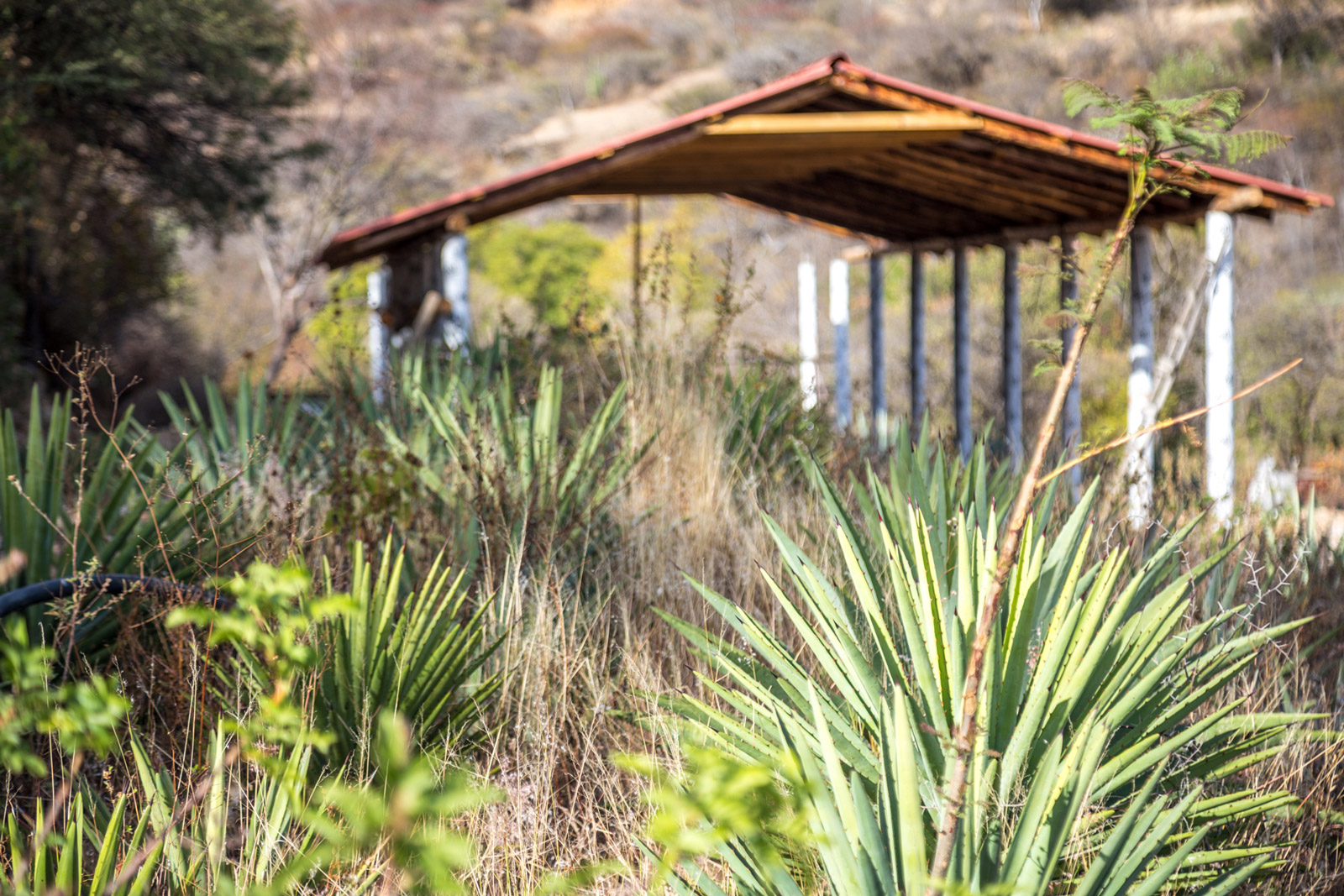
Mezcal production obviously starts from the land. A farmland that, like in Santa Maria La Pila north of Miahuatlán, can change color from Roland Garros red to black clay to light sand in less than a hundred meters. Or a harsh, untamed land like the mountains of San Pedro Taviche or the Nueve Puntas around San Baltazar Guelavila, home to over thirty wild agave varieties suitable for distillation, growing tall and proud under the scorching ball of the jaguar sun. There's the orderly Espadin of an elegant green-grey color, the huge Tepeztate stretching its broad leaves through the brambles like an octopus, the small Tobalà looking like thorny lettuce heads, the small tree-like Tobaziche and Madrecuishe... Regardless of the huge morphological variety, the harvesting technique is the same. What changes is the way – and difficulty - of transporting the piñas, either on trucks or muleback.
The hombre de campo – the person in charge of the maguey – first identifies the mature plants that have grown a quiote, the flower stem that indicates maturity and grows when the agave is between 5 and 25 years old. He then proceeds to "neuter" them (capar), cutting the stem before it reaches the flowering and pollination stage, after which the plant dies. Lastly, 5 or 6 months later when the nutrients intended for reproduction have been absorbed back into the plant's core, harvesting can begin.
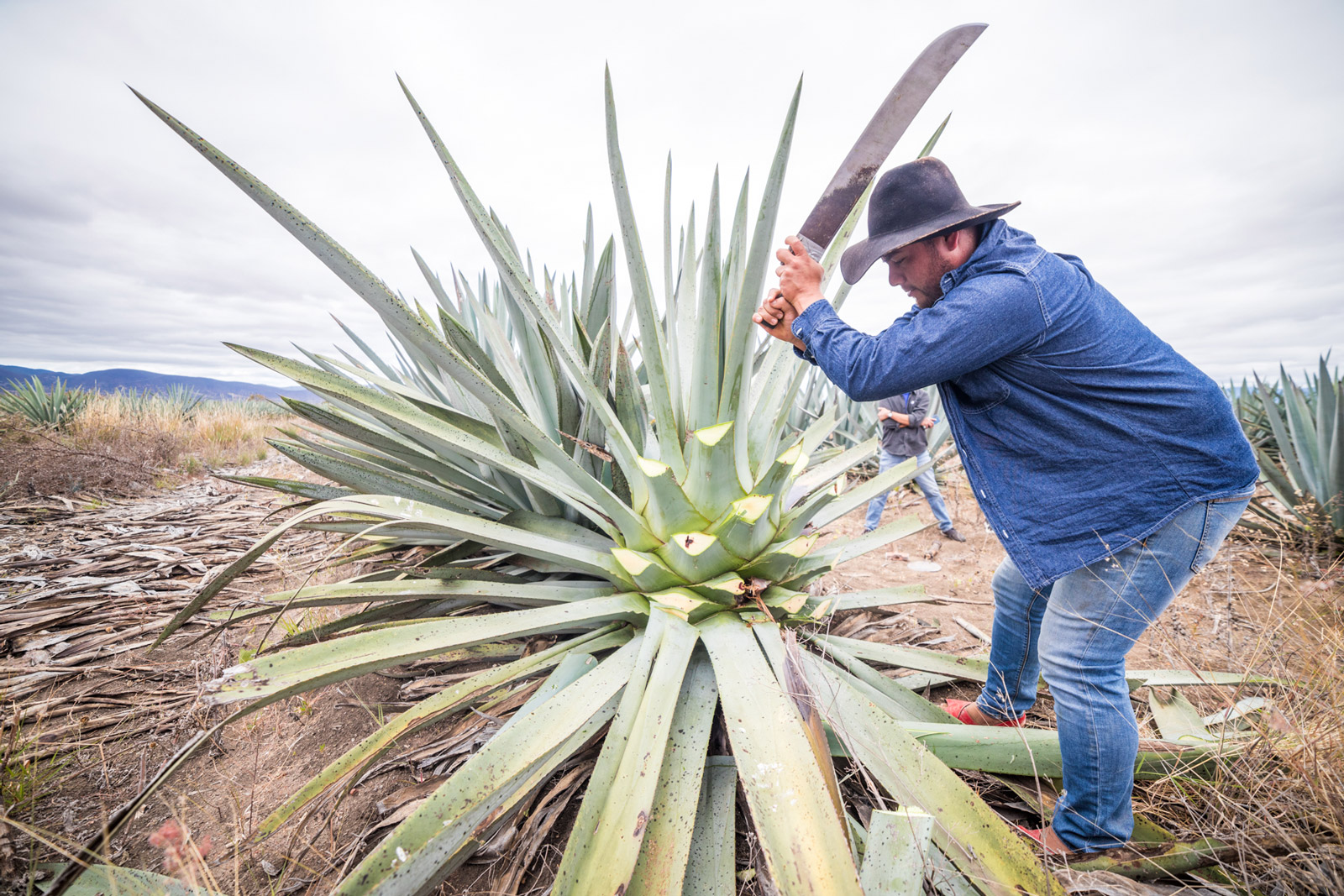
Semei, Don Valente Garcia's nephew, is a machete whiz. With sharp blows he cuts the pencas, the broad leaves of a Coyote maguey, down to a length of a span. The stubs will be used to make the piña easier to handle. Next up is the man armed with a coa, a round, sharp shovel that is driven into the base of the piña with a club to cut the root. The maguey cores - which weigh an average of 90 kg for Espadin agave and can reach 550 kg for a Sierrudo agave - are now ready to be taken to the palenque for baking.
Baking (with a
Baking agave is essential. Maguey contains the oligosaccharide inulin, a carbohydrate composed of monosaccharide chains: fructose and glucose. Baking is essential to break down these chains, ensuring that the yeasts can attack the simple sugars and turn them into alcohol during fermentation.
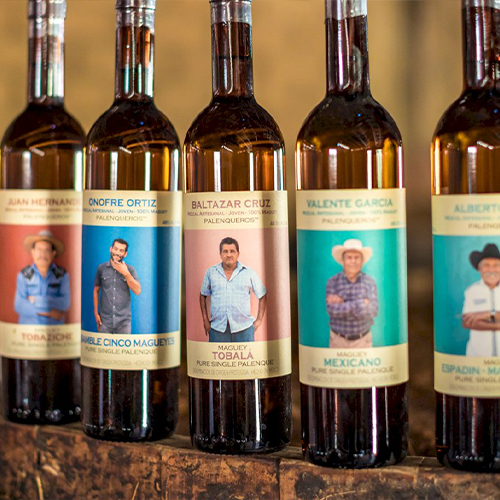
If industrial mezcal can be produced from agave cooked in autoclaves, for craft mezcal this stage almost always takes place in a conical oven dug into the ground called horno de pozo (the specification allows masonry ovens, but they're rarely used). Each family of palenqueros has one in their courtyard, with children playing and dogs roaming all around. It's a hole that resembles Dante's hell, but less horrifying. The walls of the "well" are usually lined with stone and concrete, and the size may vary. The recently built oven in don Juan Hernandez's new distillery in San Pedro Taviche can contain 3 tons of piñas; Alberto and Onofre Ortiz's in Bramaderos is larger, with an 8–10-ton capacity; don Valente Garcia's two ovens in nearby Santa Maria La Pila can contain 24 tons and are almost record-breaking.
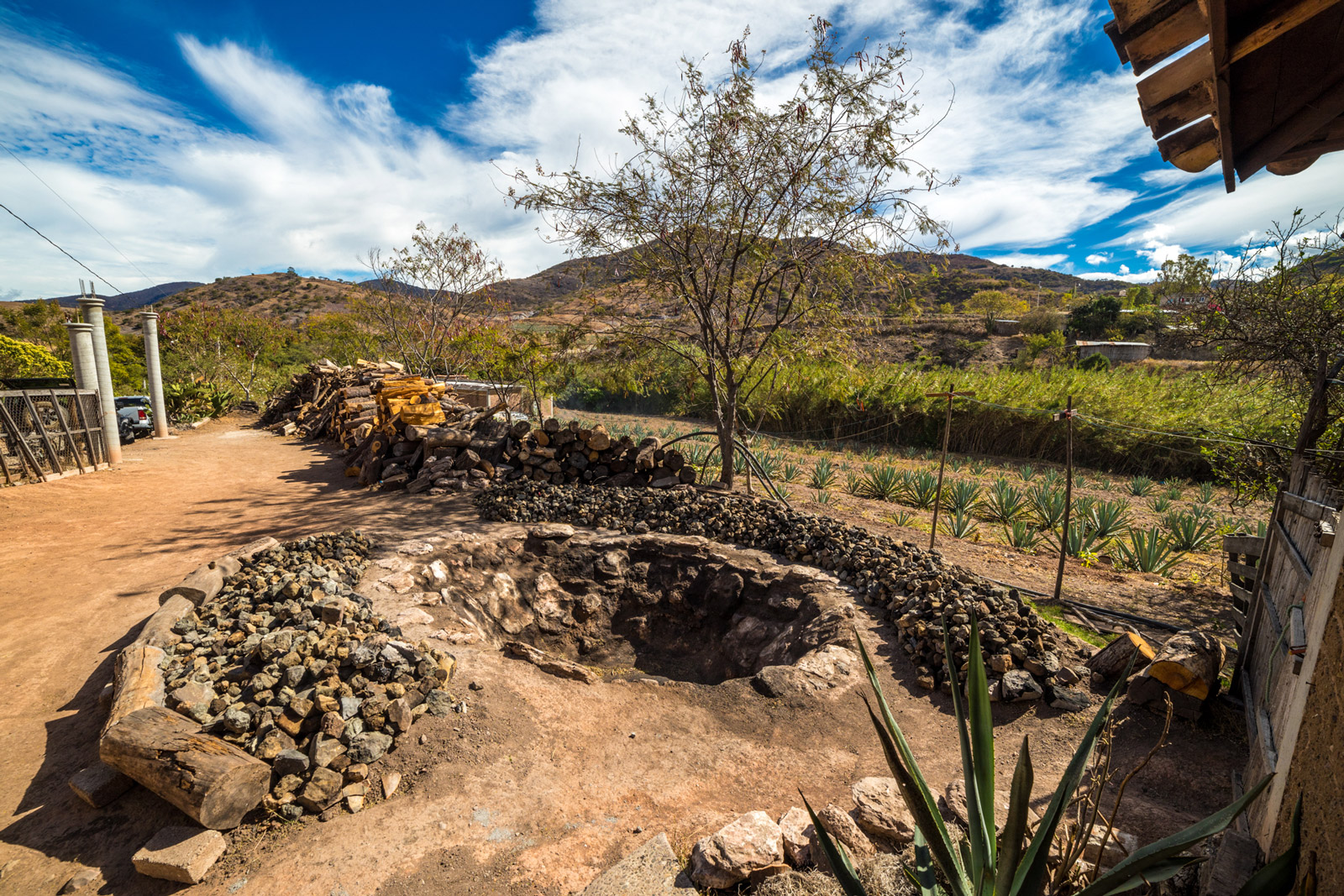
Baking is a convivial time involving the whole family - which fortunately today includes women, banned until just a few years ago because the superstitious Mexican rural society believed their presence prevented the agave from cooking properly. The bottom of the well is filled with several cubic meters of mezquite or encino negro, a local oak. This is set alight and covered with a layer of rocks and one of vegetable fiber, not infrequently consisting of agave leaves. Next come the piñas, which form a heap rising up to 1.5 meters above the edge of the oven. Everything is then covered with petate, a mat made of palm leaves, and a layer of dirt of about 20 cm. Some start at 5 in the morning, like the Hernandez family, some in the evening. Either way, it's not something you get done in microwave time...
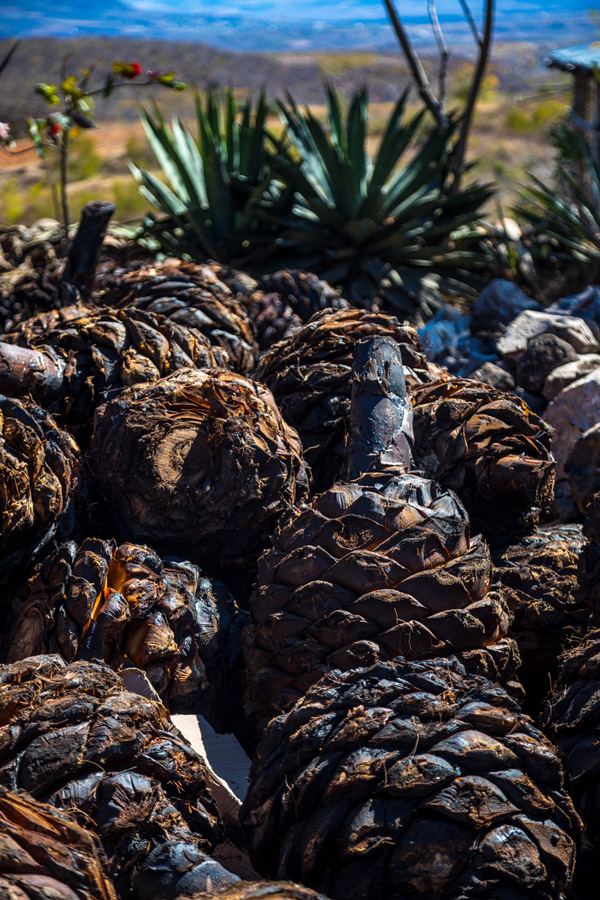
Of course, everyone goes about this their own way. Don Beto and his son Onofre are quite meticulous and leave the maguey out on the courtyard floor for two days before baking. Then they take 12 hours to light the fire properly and get live embers before arranging the piñas. As a curiosity, they're the only ones we saw leave a "stump " of quiote attached to the piñas like a stalk during baking. They do this to better arrange them in the oven and ensure the stumps protect the piñas from direct fire to keep them from burning. This is because, contrary to what one might expect, agave is not cooked over charcoal but as in a huge tagine, where it absorbs the smoky, earthy, grassy notes typical of mezcal. Fun fact: Don Valente Garcia's is the only distillery where we found an oven covered by a small canopy tent. It's quite unusual, but the Mexican government is investing a lot in the industry and also funds this kind of improvements.
Once the oven is covered over, the heat – stored by the embers and rocks and trapped inside by the soil – cooks the agave. Baking can last up to seven days, but most palenqueros are happy with three or four - not that anyone sets a timer or an alarm.
"All you need is your hand," explains Onofre Ortiz. "If after one day you burn your fingers when you touch the ground, everything is going well and three days will be enough for baking. But if after one day you can easily keep your hand on the ground, that means the heat is dissipating quickly and it will take four days."
Forget digital, that's the "hand timer" for you.
Donkeys and hammers - the molienda
Once baked, the piñas are left outside for a few days. It's a feast for the senses to breathe in the sweet smell they give off, taste their heart, sweeter than sugar cane, and observe the insects buzzing around.
"Insects are important," explains Hector Vásquez, head of the Palenque project. "More insects means more microorganisms, or more wild yeasts, which are essential for fermentation."
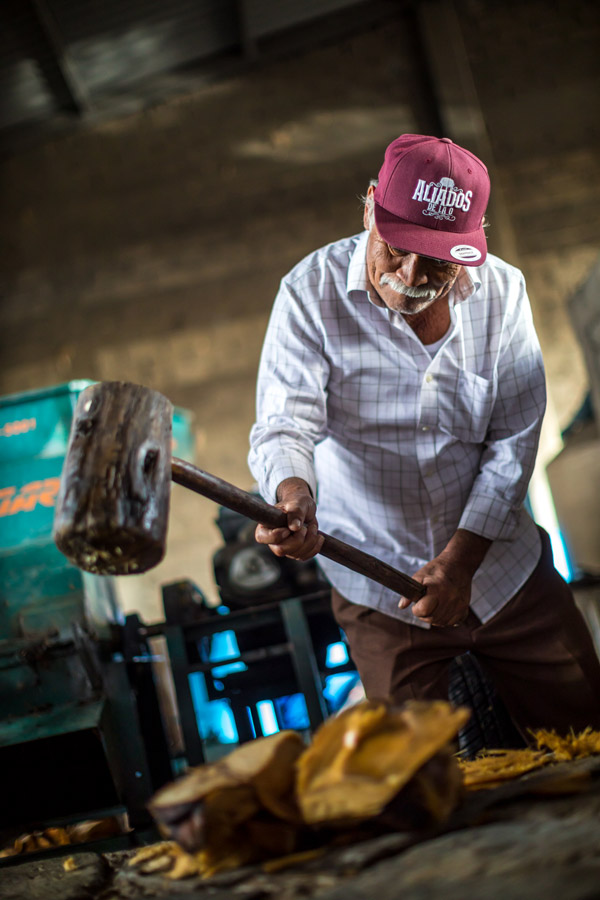
Before moving on to this stage, however, you have the molienda, that is, the grinding of the agave to help fermentation.
The first step is rebanar, or roughly cutting the piñas with a machete. After that, production paths diverge. The traditional way is manual grinding, which can be done two ways - with mazo y canoa or with a tahona chilena.
The first is demonstrated by Don Beto and Onofre Ortiz: they simply arrange the pieces of baked agave on a kind of stone mortar and start crushing them with a heavy wooden club. It's exhausting work, especially when grinding agave of the Karwinskii family such as Tobaziche or Madrecuishe, whose cores are very hard.
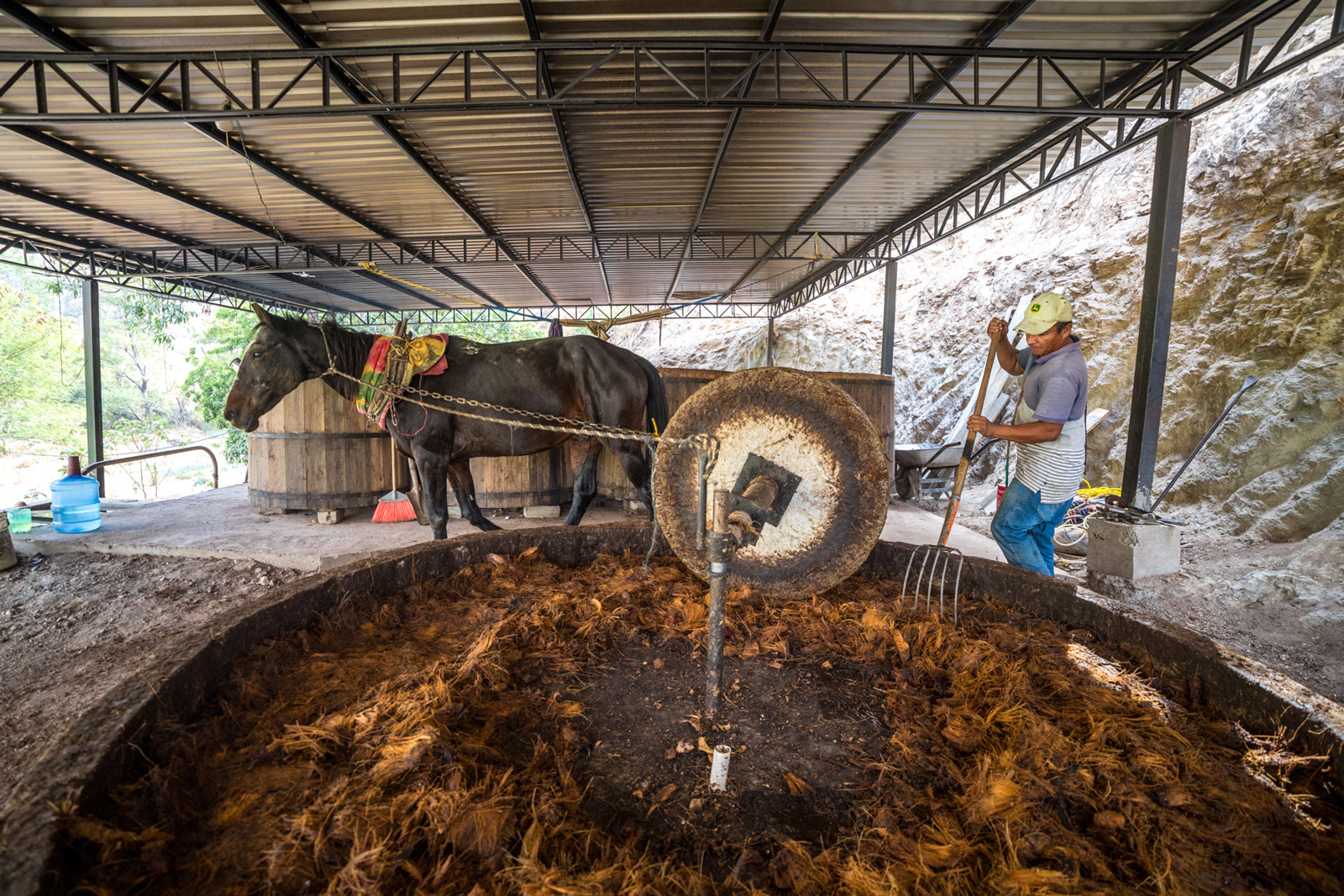
The second traditional method involves the use of draught animals driving the stone wheel of a mill, as is often the case with sugar cane in the Caribbean. In his distillery in San Luis del Rio Don Baltazar Cruz uses a horse, which takes one and a half hours to grind a 550 kg tub (tahona). They can fill three a day.
The so-called desgarradora, or mechanical grinder, is another story. It's allowed by the specification and all traditional producers are now equipped with one, as it saves a considerable amount of time: it takes half an hour to grind what four people can mash in 8 hours using a mazo. Yet, no one uses a desgarradora for the mezcal bottled as part of the Palenque project. The reason is organoleptics - mechanical grinding results in an overly dry bagazo, or ground agave fiber.
"We've done blind tests with mezcals produced from hand-ground and mechanically ground maguey," explains Hector. “The former are always better."
That's why many remove a few blades from the machine to chop the agave more coarsely and have a wetter bagazo.
Again, adelante with technology, but con juicio...
Fermentation, wild magic
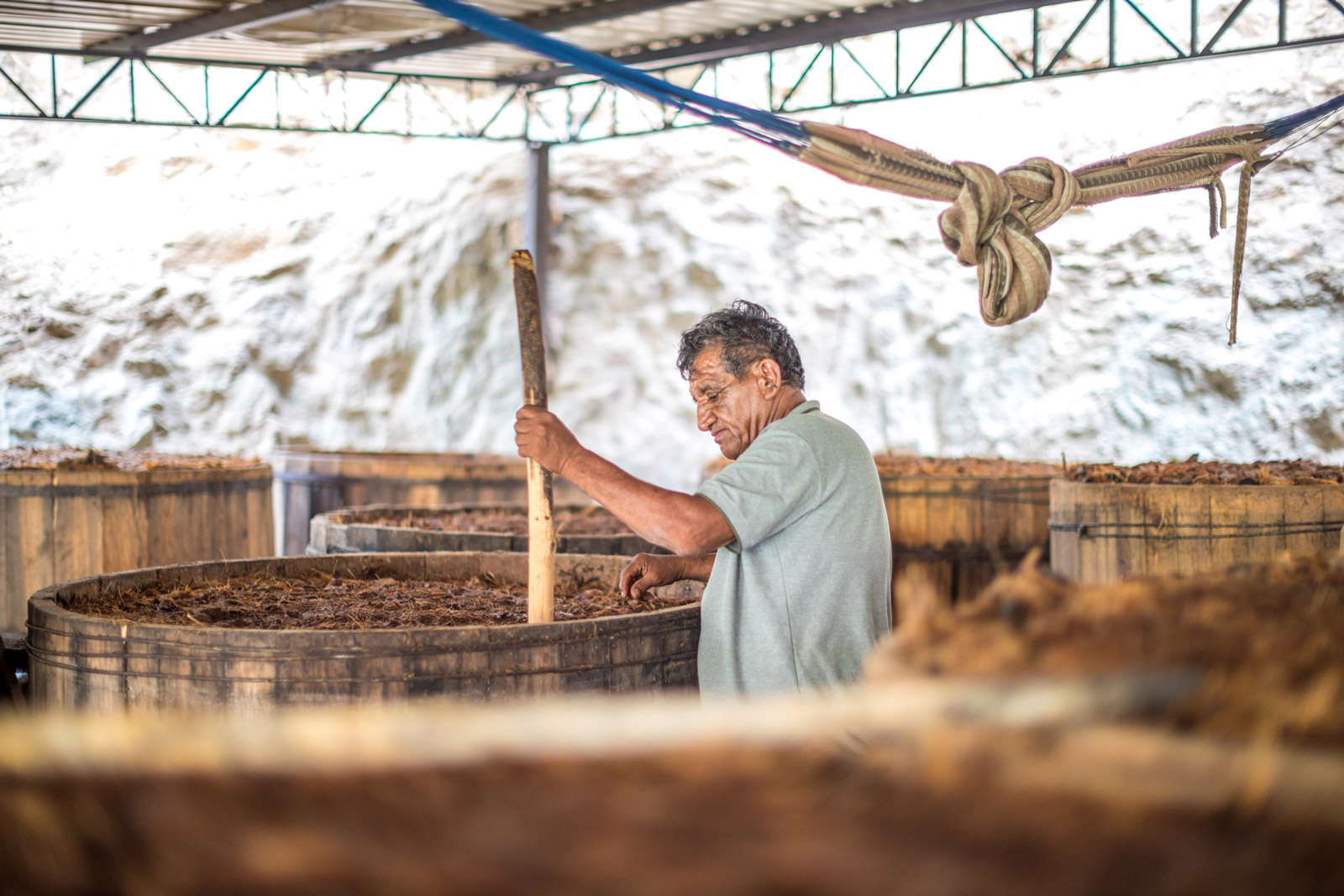
Once the baked agave has been mashed, fermentation needs to be kickstarted. Here's where things possibly get even more random and unpredictable. The agave is placed in fermentation vats most often made of wood. The most common type of wood is pine (don Juan Hernandez, don Beto Ortiz) but ocote (Pino di Montezuma) as well as oak, called encino (don Goyo Martinez), are also widespread. However, the most valued and traditional wood is sabino, an increasingly rare local cypress tree which we've seen used for Don Valente Garcia's vats.
The vats have variable capacity, even within the same distillery. Don Juan uses four 1000-liter vats, Don Beto and his son Onofre have eight 1400-liters, Don Baltazar has the smallest, twelve 550-liters, and Don Gregorio four 1300-liters. Only Don Valente has 14 with different capacities ranging from 1000 to 2000 liters.
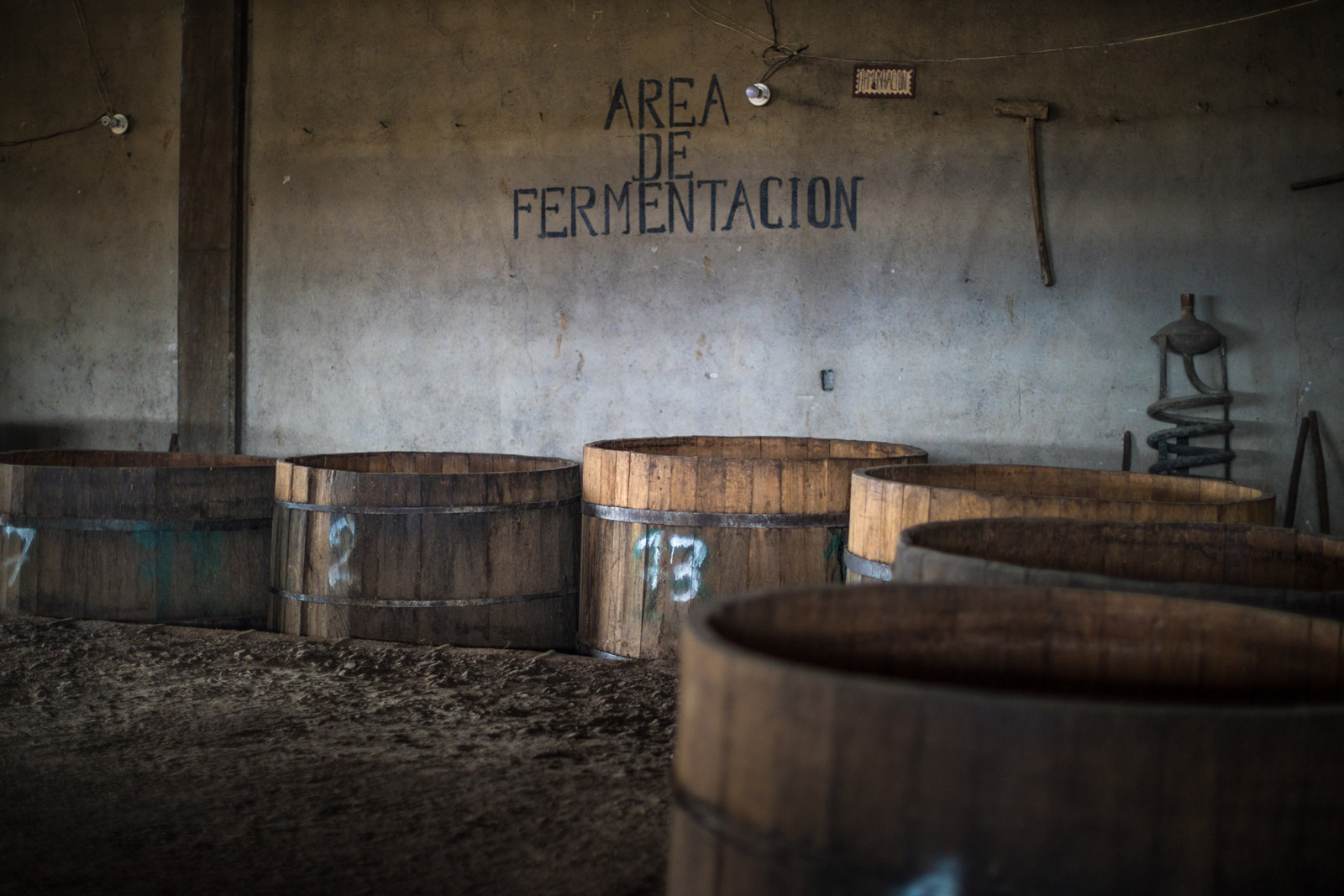
Regardless of capacity, the vats are filled with agave mash – usually using wheelbarrows and pitchforks, so much for automation – and left to rest for a day or two before adding water. This is done to attract the insects carrying the wild yeasts present in the air and the environment, which kickstart the process. With the exception of a single brand, craft mezcal is not produced with the addition of selected yeast strains but through wild fermentation. This involves the specific microorganisms present in the air in a certain place; this is one of the reasons why the same agave variety develops totally different flavors depending on the place where it's processed.
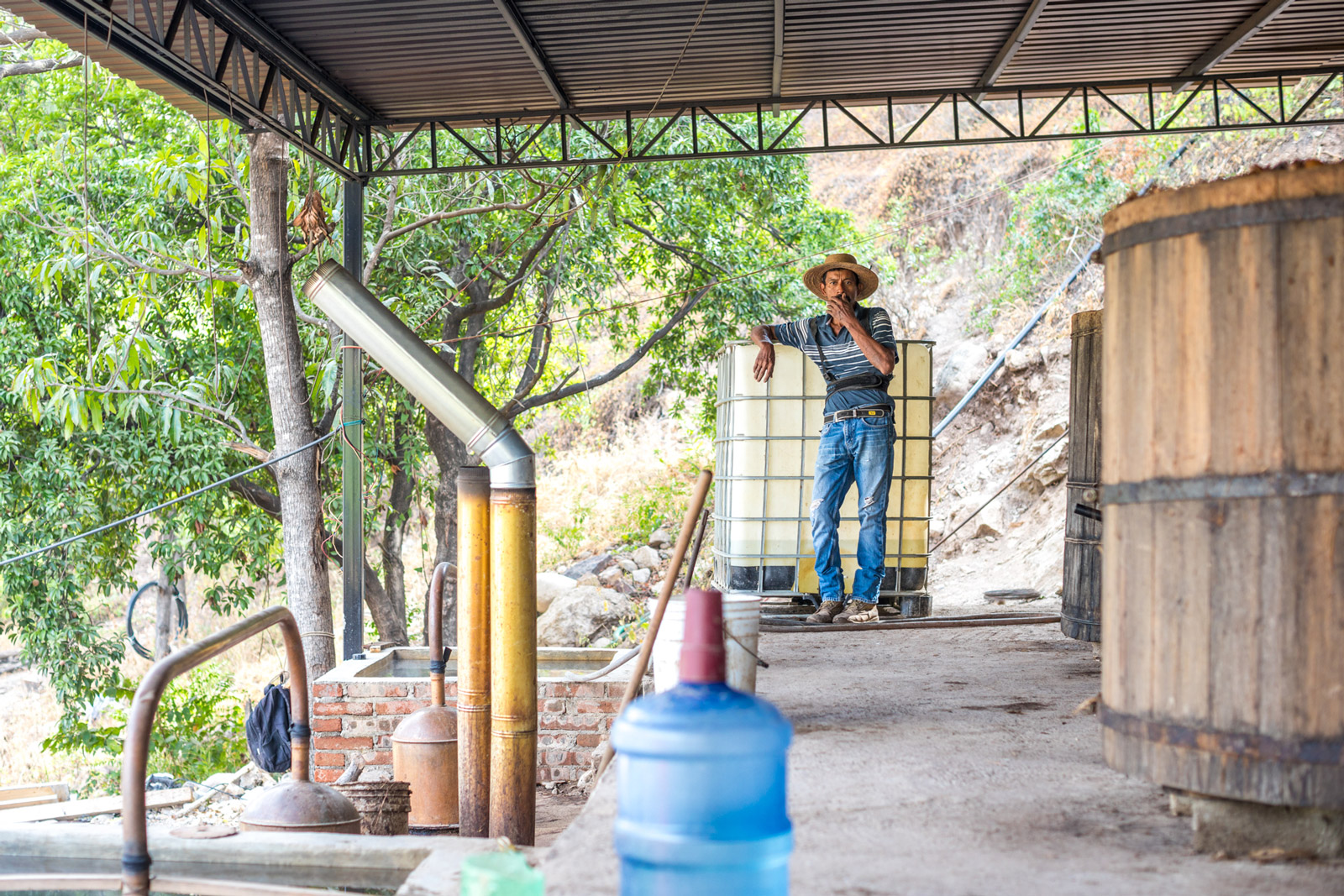
The idea becomes clear when looking at the architecture, so to speak, of the palenques. The Hernandez family's new distillery has minimal roofing and no walls, as does Don Baltazar's, which means more wild yeasts finding their way in. Don Goyo Martinez's distillery, on the other hand, is made of wood, cozy and closed on three sides, ensuring greater stability and protection for the yeasts.
Once water is added, fermentation techniques and times vary depending on the season (temperature being the most decisive factor), the distiller's "hand" and the maguey variety being processed. The average for a batch of farmed Espadin maguey is 7-8 days, faster during the hot season and slower during the cold one. That's why distillation stops in the winter: when the temperature drops below 20° C, fermentation is difficult to start and would take too long. Don Valente Garcia devised an interesting solution to this problem. The heat from the live fire heating the stills is conveyed to the fermentation vats through a kind of in-wall insulation system, ensuring a higher temperature and reducing fermentation time.
As mentioned, agave variety is also a factor. The more carbohydrates it contains, the faster the fermentation; the more fibers, the more difficult; the more saponin it contains – like Tepeztate (Agave marmorata) and especially Jabalì (Agave convallis) – the more foam it will produce. For this reason, the vats are filled to different levels depending on the expected increase in volume.
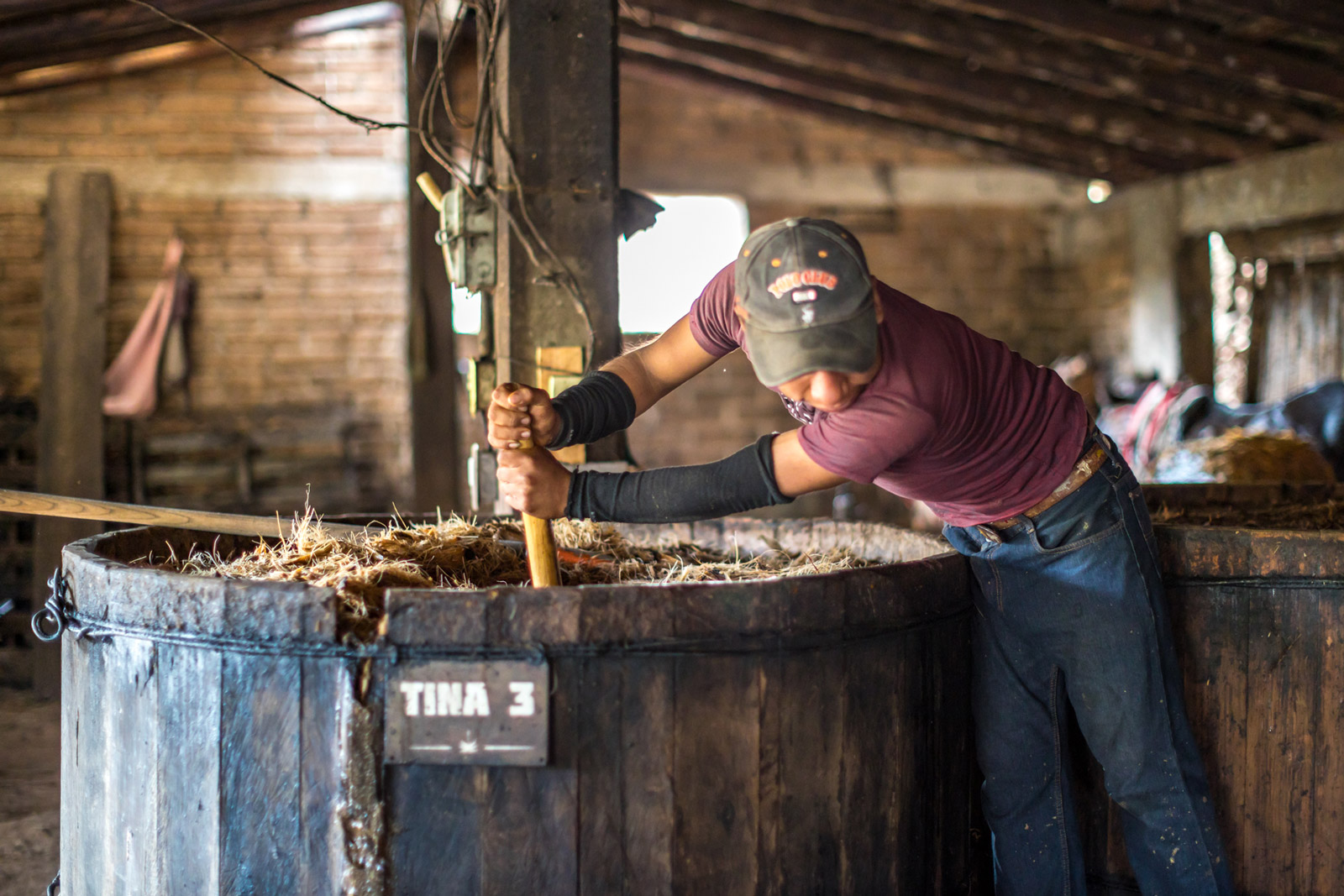
Time isn't the only variable - techniques vary as well. At don Juan's in San Pedro Taviche, they can tell when fermentation is over "by ear": they just put their ear to the vat and listen for bubbles. The Ortizes in Bramaderos place pieces of wood and rocks on top of the vats to ensure the agave fiber remains underwater. Conversely, at Don Baltazar's in San Luis del Rio the fiber is allowed to float and create a plug on the surface, enabling fermentation to occur with less oxygen underneath. What everyone does is remontage, which consists of stirring the vat to bring the must lying on the bottom to the surface and redistribute the yeasts more evenly.
Don Gregorio is the only distiller we saw make further use of the fermenting agave fibers by crushing them on the bottom of a vat. We asked them why. "To plug the holes in the wood, of course," was their candid reply.
Heads, tails and eye: the distillation
Once fermentation is over, the Maestros mezcaleros have what they need: tepache. Which only shares the name with the fermented pineapple drink found in the colorful, fairy-tale-like street markets like the one in Tlacolula de Matamoros. This tepache is simply the fermented, acidic and slightly alcoholic mixture (most often around 4% ABV) that's placed into the stills.
As mentioned, the specification bars producers of mezcal artesanal from using column stills; distillation must take place in pot stills, meaning batch distillation.
"There's also another method, now almost forgotten," clarifies Hector. "The dome of the still, the montera protruding from the masonry structure is immersed in cold water in the refrescadera. Once the vapors from the first distillation reach the top and return to the liquid state due to the copper being immersed in cold water, they fall back down. This happens three or four times, so the vapors are redistilled in the same still. Then the refrescadera is removed and the spirit is allowed to drain. In essence, it's a sort of double distillation in the same still. Today this is increasingly rare."
All of the palenqueros we visited use copper stills enclosed in brick and concrete structures with the monteras jutting out, looking like helmets sitting on low walls. The stills are quite similar in capacity, ranging from Don Valente Garcia's 350 liters to Don Baltazar's 300 liters down to 250 liters for Ortiz, Don Goyo and Don Juan. They're all heated by direct wood-fire. We saw no steam coils or ancestral terracotta stills (olla de barro). Tradition here requires copper and masonry, and that's fine. The still is loaded with liquid and bagazo, i.e. without removing the fiber. Once that's done, it's time to rumba.
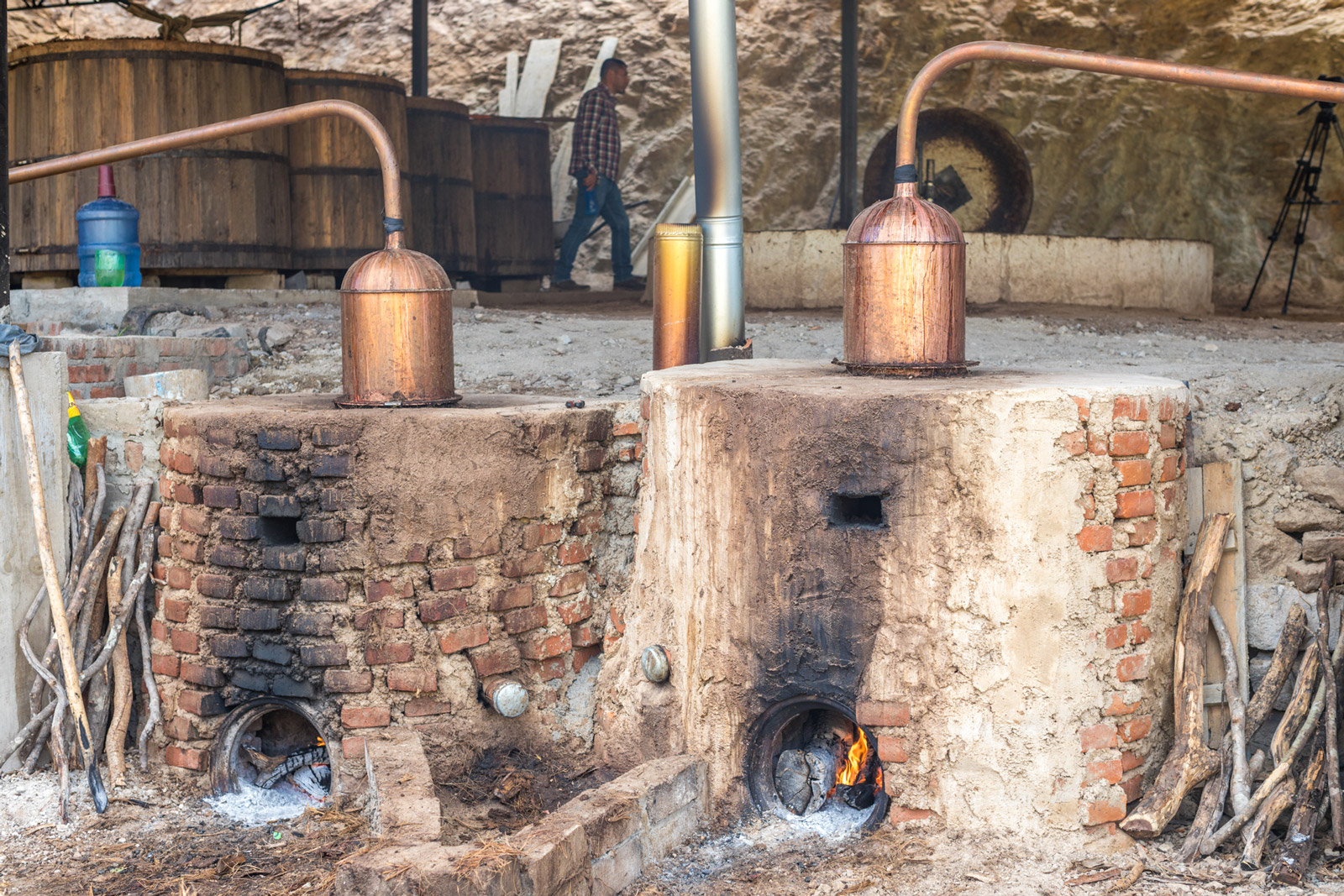
The first distillation lasts a variable amount of time depending on the style of the house and the type of maguey. It can last 3 hours like at Don Juan Hernandez's small distillery or as long as 8-10 hours like at Don Beto Ortiz’s and his son Onofre's distillery. At Don Valente's, Don Baltazar's and Don Goyo's it lasts 4 hours. It works the same for all of them: no cuts are made during the first distillation. The resulting liquid is called a thousand names - some call it shishe, others comun and others still ordinario. It has a fairly consistent alcohol content ranging from 19-20% (Don Valente) up to almost 30% (Don Juan), averaging around 25%. The yield is also quite consistent, about 1/5 or 1/6 of the still's capacity - except for Don Goyo, whose 250-liter stills only yield 25 liters of ordinario.
Once the liquid from the first distillation has been collected in special plastic tanks that by European standards wouldn't even be fit to store waste motor oil, the still is emptied and prepared for the second distillation, and that's where the Maestros mezcaleros' senses and intuition come into play.
Now, you need to sweep aside all your memories of the accuracy of large single malt distilleries. Here, what they do is taste and cut empirically. That's right, in the second distillation cutting is inevitable: the puntas, the heads, and the colas, the tails. As to how and when, each producer does as he likes or as he has been taught.
For example, at don Juan's the second distillation lasts 8-9 hours and yields about 75 liters of "heart". The heads and tails, which are distilled again like at Don Baltazar's, are cut by simply sniffing at the spirit flowing out of the still - both don Juan and his children suffer from diabetes and no longer drink, so they have become artists of pure olfaction. The yield depends on the type of maguey and the amount of carbohydrates in the plant. It ranges from 75-80 liters for Espadin mezcal to 60 liters for Tobaziche and even less of Tobalà, for which you need as much as 20-25 kg of agave to produce a single liter of spirit.
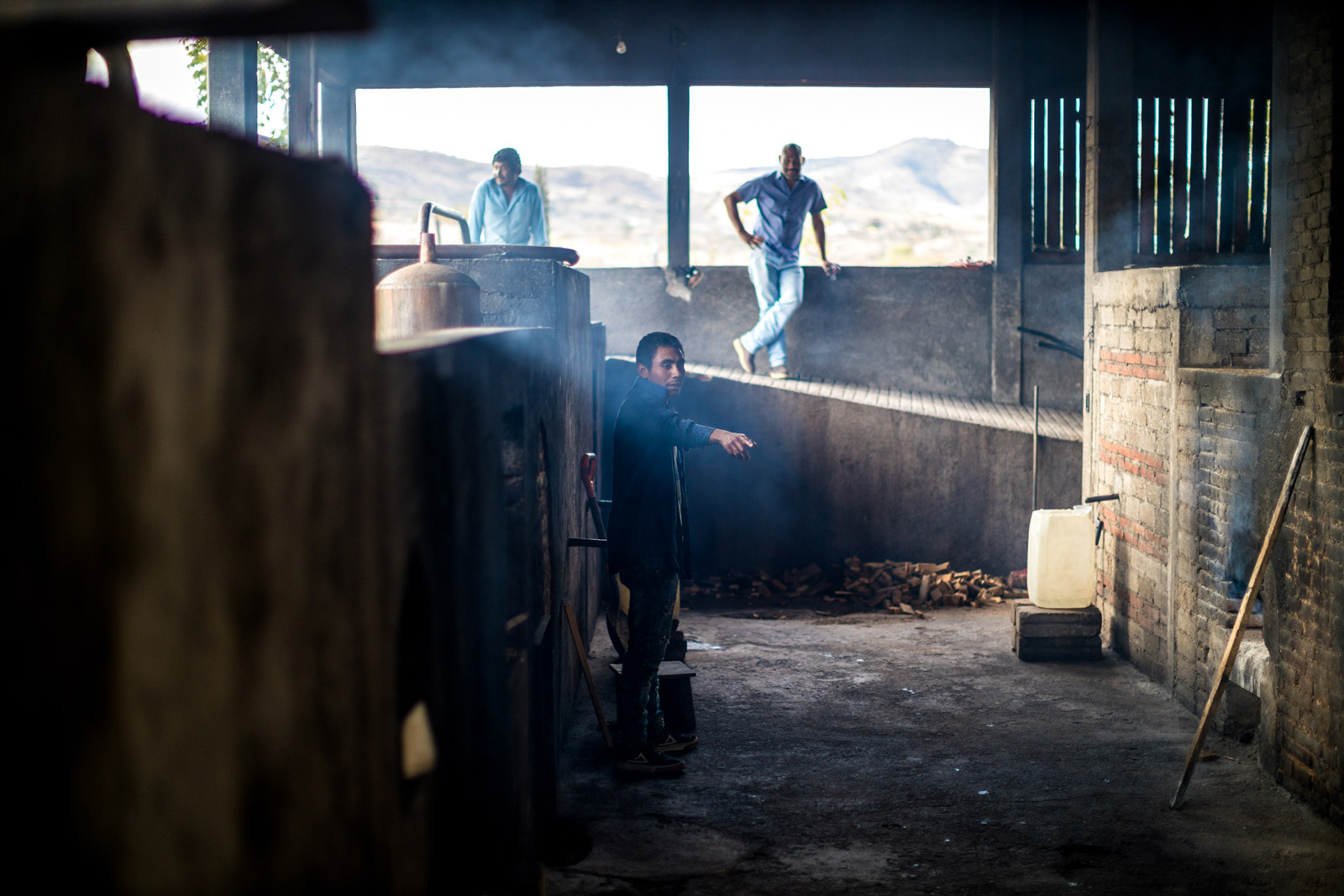
At the Ortizes' things are done differently: the second distillation lasts 14 hours for Espadin and up to 20 for Jabalì agave, which needs very low heat to avoid producing foam that would make the spirit yellowish. Don Beto and Onofre don't cut the puntas as much as the specification requires. They made this choice because they want to preserve the concentrated aromatic esters found in the heads, which give mezcal its fragrance. This is something worth fighting the specification and even leaving the certification scheme for, at the cost of writing "agave spirit" instead of "mezcal" on the label. The tails, on the other hand, are cut "manually": they wet their fingers with the spirit, rub them together and smell. If the smell is acidic and not alcoholic, they cut. The heart is about 75 liters and the alcohol content at the exit point is 48%.
At Don Valente's, where the palenque is larger, better structured and produces up to 40,000 liters per year, the second distillation takes 7-8 hours. Here everything is based on the spirit's alcohol content at the exit point of the still, which must be 49%. With Espadin, which has a higher sugar content and tends to produce a stronger mezcal, water is added to the fermented liquid when loading the still, or the still is loaded only up to 250 liters. During distillation, 6 liters of heads are cut, then another 10 liters for the second cut, which leaves 80-100 liters of heart before cutting the tails. Puntas and colas are then used to componer, or "adjust" and standardize the final ABV.
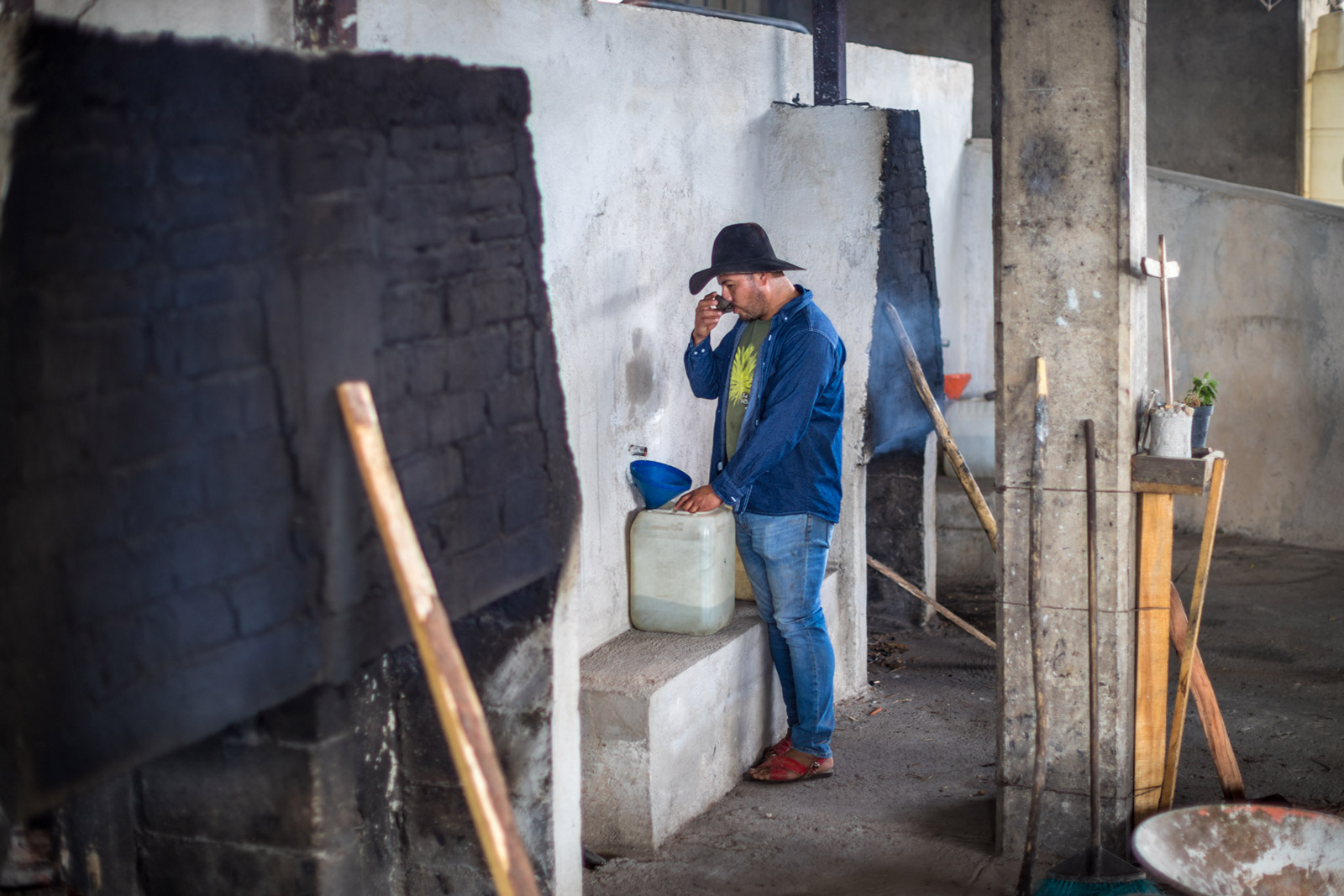
The lower-grade tails are added back to the heart in a process that the new rules discourage - the specification recommends using distilled water to adjust the grade, but – in case it wasn't clear – here tradition overrides regulations, including in the matter of alcohol content. Semei collects the mezcal with a venecia, or small bamboo tube. He pours it into a jicara, a small bowl made from a kind of small pumpkin and used to drink mezcal. If the falling liquid creates dense medium-sized pearls radiating out from the center of the bowl and creating a kind of necklace lasting more than a few moments, the grade is perfect at 48-49%. Below 45% and above 54%, on the other hand, the surface tension changes and the pearls disappear immediately. And that is why you don't need an alcohol meter.
At Don Goyo Martinez's things are different still, as his son Eduardo cuts 3 liters of heads and leaves the tails in the still for the next distillation. By not removing the low-grade tails the resulting mezcal is particularly strong at between 50% and 56%, and no adjustments are needed.
A lesson - or two
Now that our trip to agave wonderland is over, and after seeing the faces of the people who live with mezcal from the first maguey shoot to bottling, we feel that in order to fully appreciate it with our heart as well as with our taste buds we need to take a step back. We need to forget European (or American) conventions, embrace the beauty of indeterminacy and the limits of strict specifications.
We are increasingly used to thinking of distillation as a science and a profession, a way of doing business. We envision futuristic plants where millions of liters are produced by a single person armed with a computer. Our very idea of quality relies on the accuracy of data and measurements.
Then you go to Oaxaca and start questioning everything.
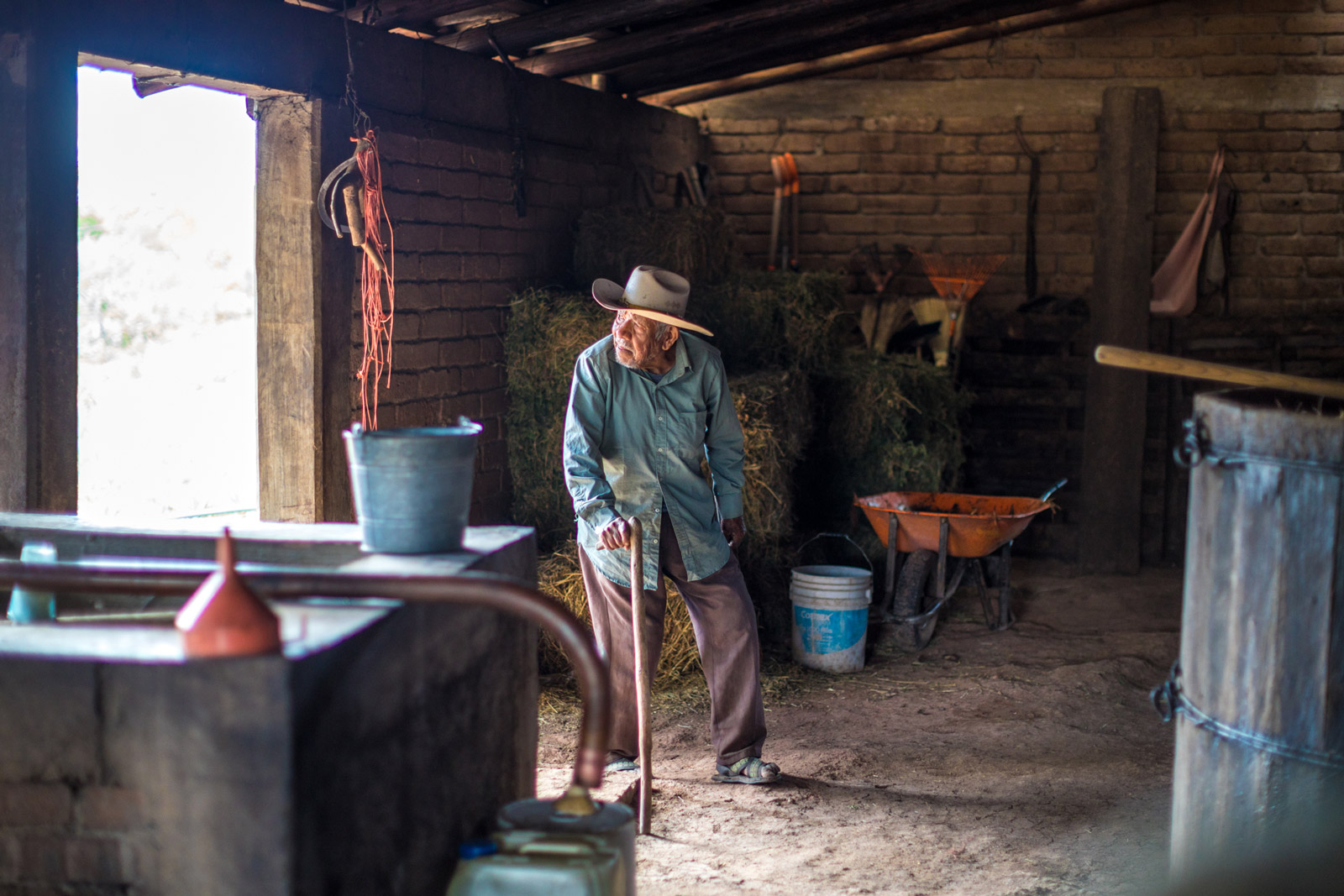
The iridescence and vibrancy of craft mezcal sweeps this mindset away. It's as if agave were a wild mongrel, like the detectives in a Roberto Bolaño novel. An independent, proud animal that will only obey an owner capable of making himself understood and accepting its nature.
Like the mezcaleros.
They who walk among the stills in their slippers and mustaches as they would among the chairs of their living room. To them, and only them, does the agave give all of itself, its mysterious variety and aromatic potential, so impossible to predict and regiment.
A treasure yet to be understood, which those who rely on cold technology will never even glimpse.


