






Caroni, a legendary rum
4 settembre 2024
This is the story of an incredible twist of fate and a gamble that paid off.
Founded in 1918 and attached to the nearby sugar production plant, Caroni Distillery has been a property of the state of Trinidad for over eighty years. It focused on the production of exceptionally aromatic rums sold by the barrel. In 2001, however, the government decided to cease production of cane sugar throughout the country, leading to the closing down of the distillery and the dismissal of thousands of workers employed in growing and harvesting sugar cane. The distillery was then wound down and literally abandoned. That changed in December 2004, when Luca Gargano traveled to Trinidad as part of a trip with photographer Fredi Marcarini with the intention of visiting the country's two historic distilleries - Angostura and Caroni. It was here that he uncovered a warehouse full of abandoned barrels. A treasure which would have been lost, but which Luca Gargano brought back to life.
«Every time I tell this story,
I wonder if it really happened.»
– Luca Gargano
Archive


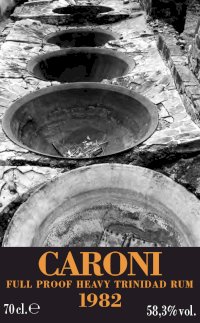


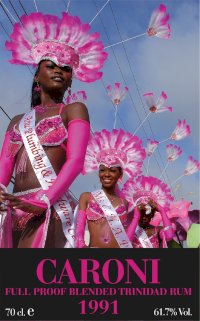


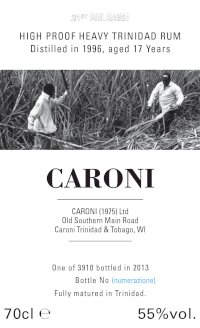


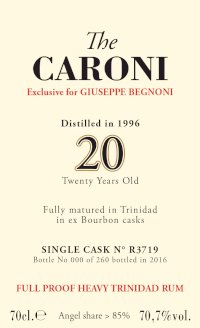



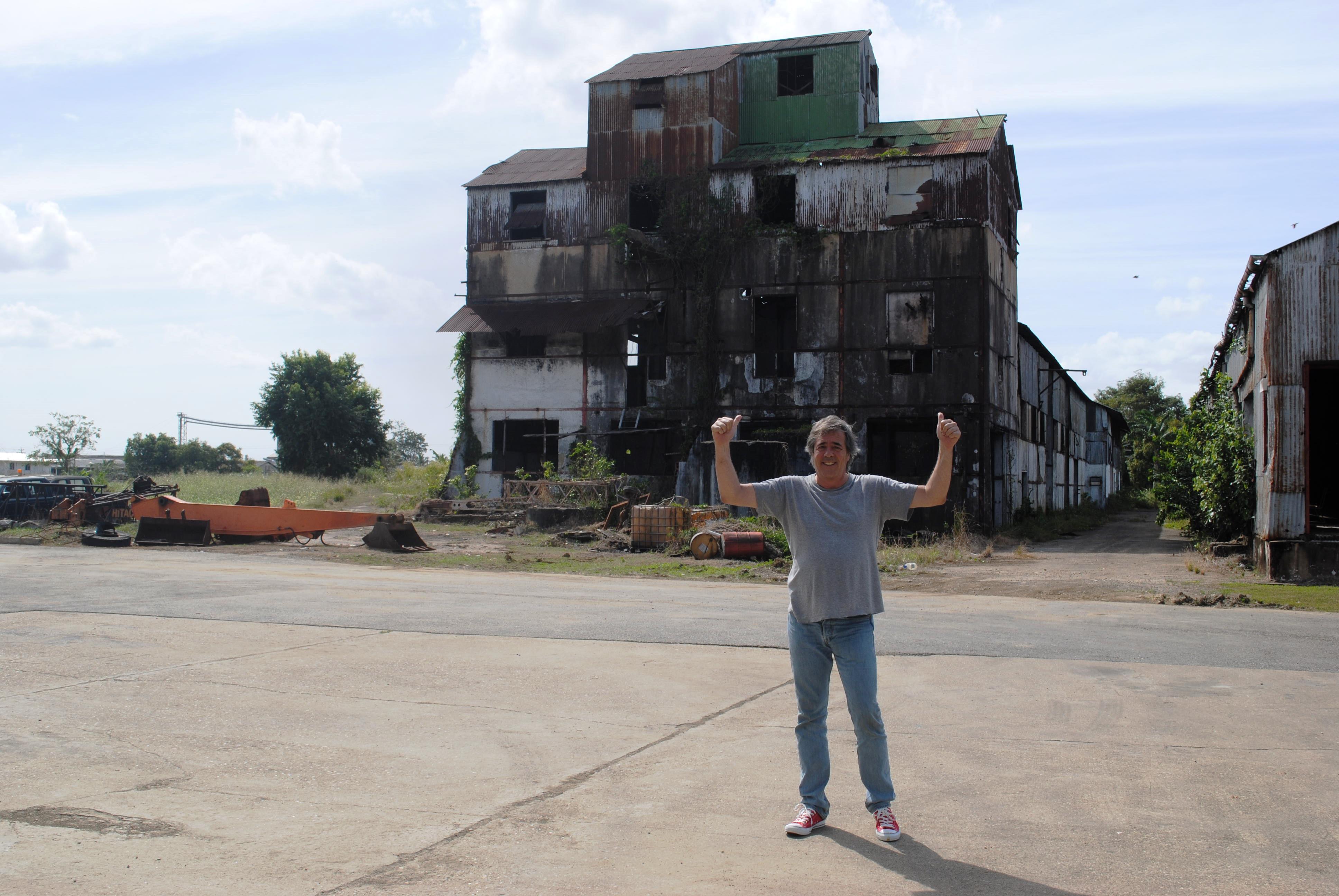
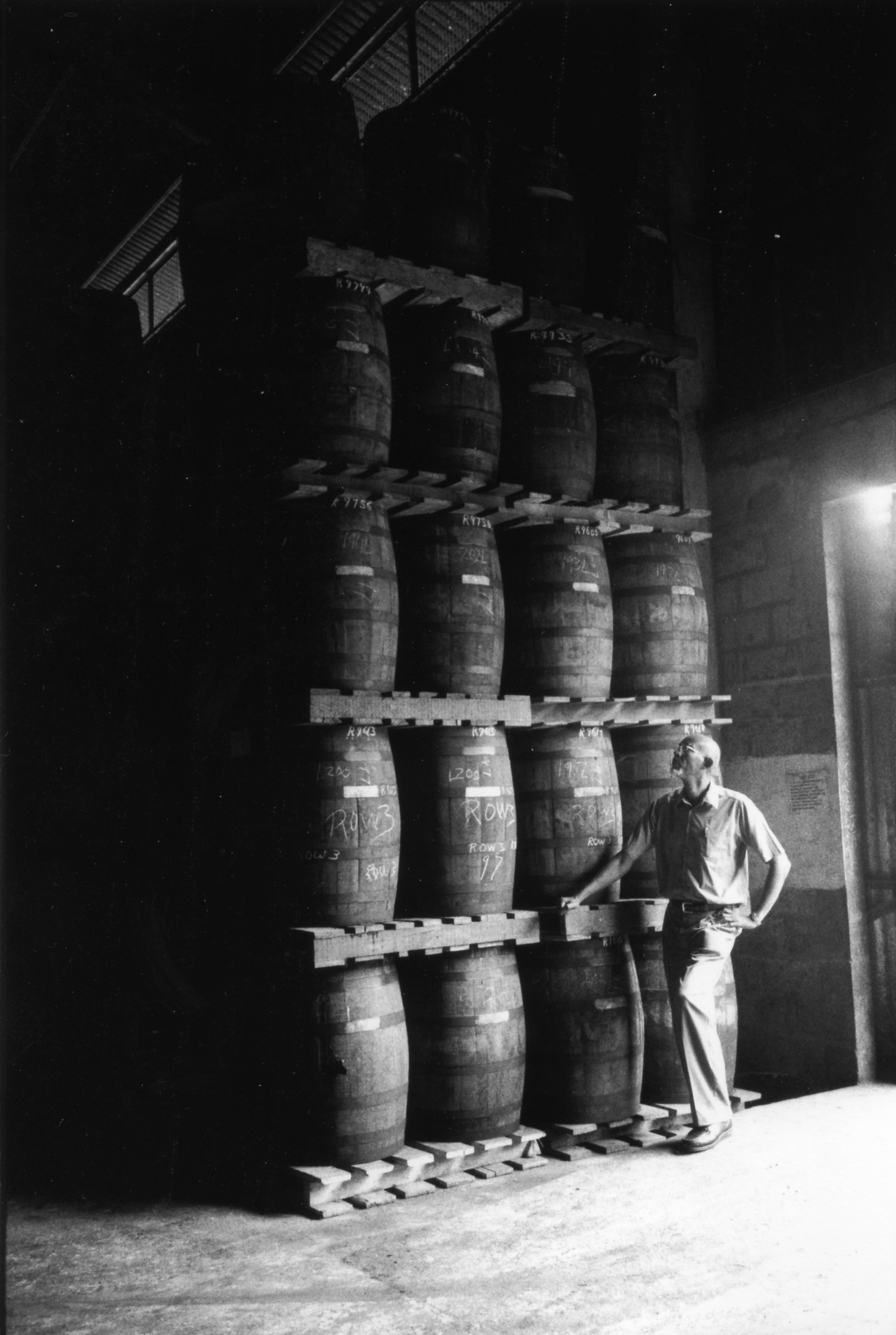
It was on 9 December 2004 when, together with photographer Fredi Marcarini, Luca Gargano landed on the island of Trinidad and visited the legendary Caroni distillery. Luca didn't know what he would find there. He certainly had no idea what a big surprise he was in for. Thousands of barrels of rum, the oldest dating back to 1974.
The buildings were abandoned," says Luca in his book Nomade tra i barili. "It was like a scene from The Day After. Tall grass covered the rails used to transport the molasses to the distillery, there was junk everywhere, the tower containing the distillation columns was crumbling and leaning like the tower of Pisa. It was a completely unexpected situation. Walking closer to the entrance gate I saw a woman inside in the distance, so I tried to draw her attention by loudly calling out to her. The woman heard me, saw us and came closer. The first thing I asked her was if this was the right place. She confirmed that was the Caroni distillery.
'What happened?' I asked her.
'What happened?' she said.
'Don't you know what happened?'
The government closed the Caroni Sugar Factory, she explained, the last in operation on the island and nationalized in the 1970s. As a result, 13,000 people who worked in sugarcane farming ended up on the street and the distillery was abandoned.
Disappointed, I asked if there were any barrels left still to be bottled. The woman looked at me, gestured and said, 'What?!' Then, 'Come with me!'.
We followed her and went in, walking through rubble, junk, pieces of sheet metal, garbage and grass up to our knees. We came in front of a large warehouse and the woman opened the doors. I couldn't believe my eyes. Thousands of barrels stacked on top of each other. Astonished, I asked her if that was only the production from the distillery's last year, that is, if the barrels were all from 2003.
'What?' she repeated. 'No! Oh! They are 1983, 1984, 1985.’
I was speechless. I was standing before a real-life treasure of the Caribbean. Even in my wildest dreams, I couldn't have imagined making such a huge discovery"
So, after getting in touch with the people owning the rights to the warehouse, Luca had samples sent back to Italy for testing. The rum turned out to be amazing.
Luca immediately bought the oldest barrels from the eighties, especially from '82, '83 and '85, for a total of about a hundred barrels. Most contained heavy rum, distilled at a lower ABV and rich in congeners; some contained light rum, distilled with a more efficient column still at a higher ABV and lower in congeners; and some already contained a blend of heavy and light rum where the ABV had already been reduced, which were probably ready for bottling. Most had an alcohol content of around 70%, but they were extremely balanced.
Luca decided to bottle them year by year and to lower the ABV of only part of the stock. He made a 1983 bottling reducing it to 52 degrees, which was still high for the time, but also bottled at barrel proof, stating that "You can't put a tie on a Rastafarian."
From 2006 to 2011 Velier purchased a total of 1388 casks, which would be bottled by year of distillation and left to age in the Caribbean.
This rum would become so popular with enthusiasts that it would give rise to a full-blown craze, the "Caroni-mania", spreading like wildfire among rum lovers and collectors around the world.
Although it had always been famous for its "heavy rums", the distillery was previously unknown as a brand in itself - it only bottled small quantities of product for the local market, while most of its business consisted in wholesaling rum to local and international producers which used it to improve their blends.
In addition to exceptional quality, there are four factors that have contributed to the value and authenticity of Caroni rum.
The first is the choice to bottle the rum almost with no reduction in alcohol content in order to preserve all its organoleptic properties. The second is the decision to continue aging the barrels in Trinidad – i.e. in a Caribbean climate, where the angel share is between 8% and 11% – to preserve their authenticity. The remaining two factors that helped position Caroni as a trailblazing rum are linked to its presentation and release on the market in the tried-and-tested Demerara bottles, this time in a dark version, featuring Fredi Marcarini's reportage-style photos on the labels.
THE HIGHLIGHTS OF CARONI'S HISTORY
1918
The Caroni Limited distillery is founded on the site of the old sugar factory on the Southern Main Road. They start distilling with a cast iron post still.
1943
A wooden Coffey still is added
1945
A copper still is added
1957
Caroni takes over the Esperanza estate and Esperanza's single-column still is transferred to the distillery
1979
A Gebr Hermann four-column still is installed
1984
The cast iron and wooden Coffey stills are replaced by a Blair two-column still and a pot still
2002
The distillery is closed down
9 December 2004
Luca arrives in Trinidad with Fredi Marcarini and discovers the Caroni barrel stock
A HISTORY OF SUGAR CANE AND RUM IN TRINIDAD
Discovered by Christopher Columbus on July 31, 1498 during his third voyage, Trinidad's initial population was 35,000 Arawaks and Caribs, which however was considerably reduced in the early years of European invasion. Used by the Spanish as a base for the exploration of the Orinoco River and for the recruitment of slaves for pearl diving on Marshelita Island, Trinidad saw the first permanent settlement in 1570 with S. Josè de Oruna, known today as St. Joseph. The island remained largely uninhabited until the XVIII century.
In 1783, incentives were offered to new Catholic settlers and the island saw an increase in population with the arrival of French people from the French Antilles. In 1797 with José María Chacon's administration Trinidad was captured by Sir Ralph Abercromby along with 17,718 inhabitants, 2,152 whites, 4,476 free slaves, 10,000 slaves and 1,082 Arawaks. With 60 distilleries the island became a major sugar cane and rum producer.
After the end of slavery, Indians and Chinese were brought in to work on the plantations. Rum production peaked in 1854, exceeding one million liters mainly exported to the UK. In 1857 oil was discovered and the oil industry became the island's largest business.
Before World War II, Trinidad was the third largest rum producer in the British domains. After the war sugar production decreased, but rum production exceeded 10,000,000 liters, 40% of which was exported. Only three distilleries survived: Caroni, Trinidad Distillers owned by Angostura and Fernandes Distillers.
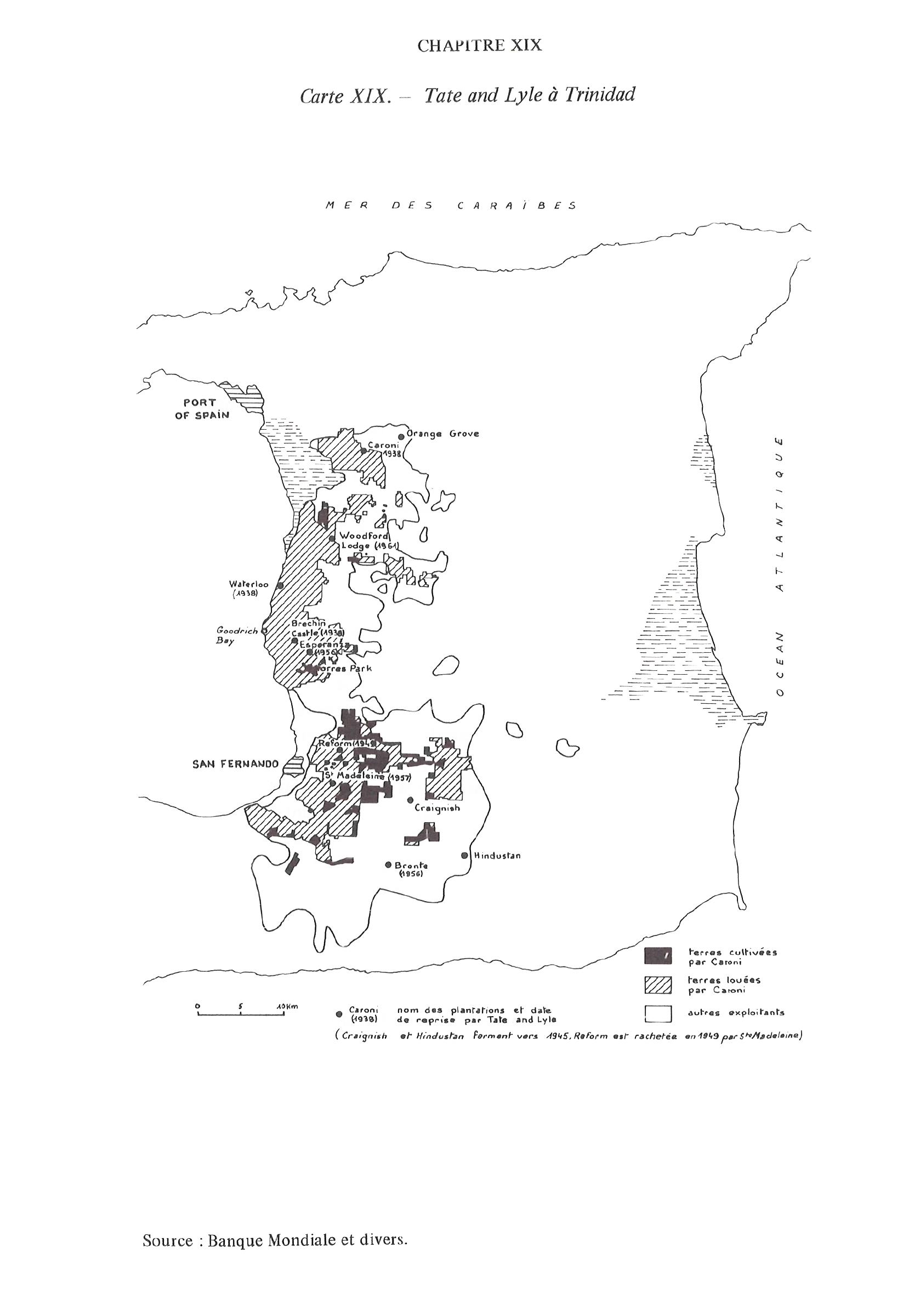
In 1973 Fernandes was acquired by Trinidad Distillers, but continued to operate as a separate brand. In 2002 the government closed Caroni, leaving Angostura as the only remaining producer on the island.
Tobago, also discovered by Columbus, remained unsettled until 1762. In the seventeenth century the island underwent several attempts at occupation by a number of European countries. In 1763 the Treaty of Paris assigned it to England, but remained sparsely populated. Slave importation began in 1770. In 1780 the population was 11,000 people, 90% of whom were slaves. In 1783, with the Treaty of Versailles, it was transferred to France, but was given back to England in 1793. Sugar cane farming and rum production resumed in 1798.
In 1884, Tobago's trade monopolist Gillespie & Co. severed relations, leading to the island's decline. In 1888, Tobago was annexed to Trinidad and in 1890 it only produced 12,970 liters of rum and 1,119 tons of sugar. In the 20 century, sugarcane farming gave way to cocoa and coconut trees.
Trinidad, the largest of the small Antilles, is located just 11 kilometers off the coast of Venezuela. With a multi-ethnic population and world-famous carnival, it stopped growing sugar cane in 2001 when Caroni was closed down. The only distillery left is Angostura, which holds a monopoly on rum production with brands including Old Oak, Forres Park, Angostura 1919 and Angostura 1824. Rum consumption on the island exceeds 6,500,000 bottles, mainly white rum.
THE PARADISE SELECTION
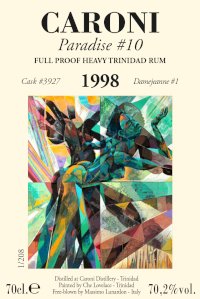
Caroni Paradise is a stunning new selection from the latest stock of the legendary Caroni rum. The selection was created during the Caroni Ceremony, which took place in Cognac on 12 April 2019, with the participation of a small group of "Caroni Lovers" - 26 experts and enthusiasts including Velier's president Luca Gargano and Maison du Whisky CEO Thierry Bénitah.
Divided into “Tasting gangs”, participants tasted the 136 barrels left from the last available Caroni stock and selected the best 23. In addition to the first selections, other "special" barrels have also been singled out for bottling as single casks and specially selected by Luca Gargano's Tasting Gang.
The rum from those barrels was transferred into 54-liter glass demijohns with a ratio of one barrel to four demijohns and stored in Cognac until now.
This exceptional Caroni selection, stored in Cognac in glass since 2019, gave rise to the Paradise series.
A total of 11 limited editions are planned.
Each label is marked at the top right with the number of demijohn the bottle comes from.
The labels are illustrated by Che Lovelace, a Trinidad artist as well as professor at the creative arts campus of the University of the West Indies, whose work is strongly inspired from the Caribbean's unique colors.
